The AI Maturity Model: From Awareness to Transformation
Assessing the value of AI is tricky. We explore the Gartner AI Maturity Model to help you measure your strategy—viewing AI not just as thinking machines, but as Advanced Information Processing.
AI is known as artificial intelligence. Assessing its value is notoriously tricky, for many reasons. To do this, it’s better to think of AI not as "artificial intelligence"—but as Advanced Information Processing.
It is the same AI everyone has come to know, but when thought of as information processing, we can view the technology as a tool rather than another thinking species. With tools, we gain the agency to create new things.
In this article, I’m exploring how companies use AI in different stages—the AI Maturity Model. I also look at problems that AI can solve and ways to adopt AI, so you can mature your AI strategy and application.
AI Adds Business Value
Machine learning algorithms help process data in novel ways impossible to achieve before. The mathematics has been there for years, but the lack of data and compute power rendered it unviable.
Today, of course, that’s changed. Machine learning opens the possibility to collect enormous amounts of data because it can both:
- Find causation from many data points (previously impossible).
- Locate pieces of data without an engineer having to build decision trees to get there.
Advanced information processing—the tool that helps us measure AI strategically—brings new value to companies. The key to remember is that AI is Advanced Information Processing.
Different companies will use its tooling differently. Not every company can utilize it the same. For example, AI holds greater value to companies that manage lots of information, and less to those who do little. That’s why we have different stages of AI that companies enter into.
What is a Maturity Model?
A data maturity model is a framework that organizations can use to assess capabilities in a specific area. It describes phases or stages of a capability’s development, efficiency, or sophistication. Companies use maturity models to plan investments, improve processes and areas of competence, and make strategic changes.
Every model is different, but in general, most follow these typical levels:
- Initial: Processes are not defined. Activities are not planned, being ad hoc and reactive. Capabilities are undefined. Without controls, results are unpredictable.
- Repeatable: Basic project management is in place. Processes are starting to emerge and key performance indicators (KPIs) are used. Outcomes are identified, with predictable and consistent results achieved.
- Defined: Documented and standardized processes are aligned with organizational goals. Team members get training, have guidelines, and work toward metrics to ensure consistent results.
- Managed: Measurements and controls are fully developed with a data-driven approach for continuous improvement.
- Optimized: Processes are well-defined, tested, and efficient. The focus is on innovation, resilience, and adaptability.
The Gartner AI Maturity Model
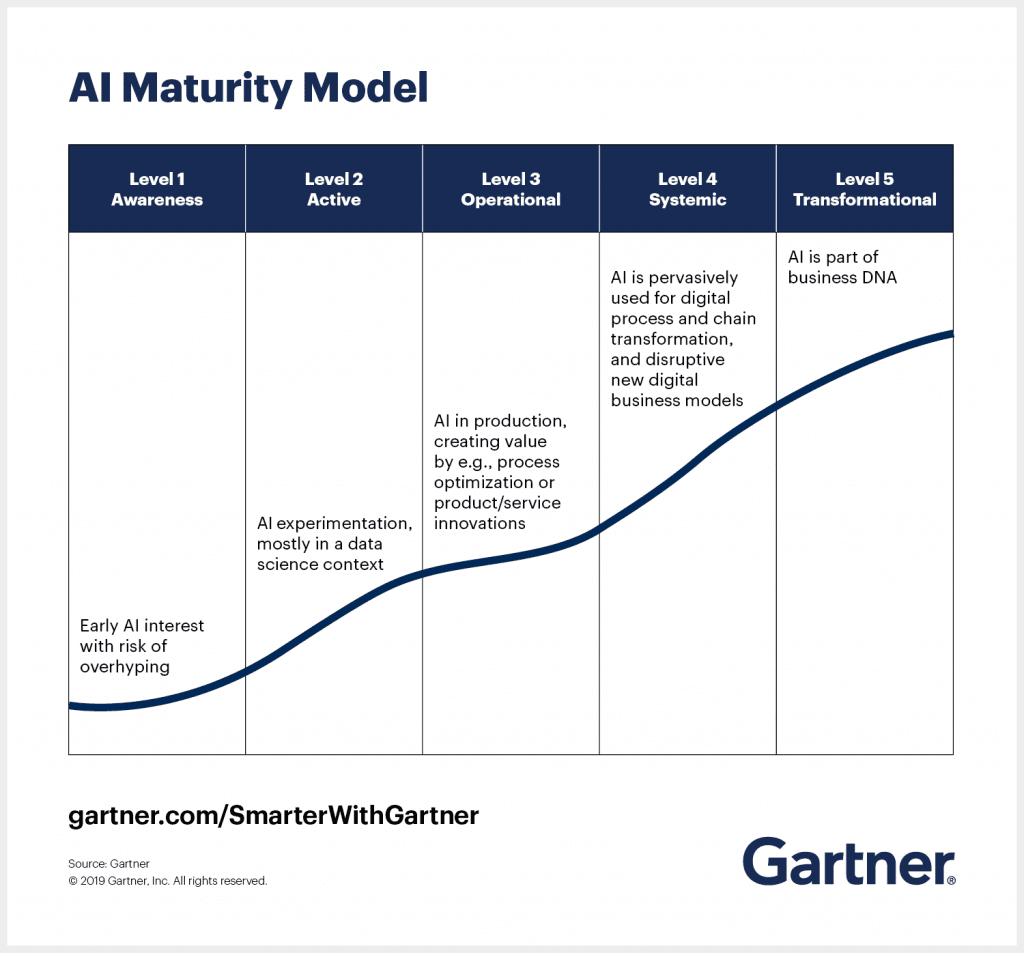
Companies will use AI in different ways. Gartner has released an AI maturity model that segments companies into five levels of maturity regarding an organization’s use of AI.
At each stage in Gartner’s maturing model, a company has a different approach to AI:
Level 1: Awareness
Companies in this stage know about AI but haven’t quite used it yet. These companies may be excited to implement AI. They often speak more of it than they know. They formulate ideas, but not strategies, for how to use AI in their businesses. Most companies today fall under Level 1—their businesses only benefiting mildly from AI.
Level 2: Active
These companies are playing with AI informally. They are experimenting with AI in Jupyter notebooks, and they may have implemented a few models from the TF.js library into their processes.
Level 3: Operational
These companies have adopted machine learning into their day-to-day functions. Likely, they have a team of ML engineers. They could be maintaining models or creating data pipelines or versioning data. They have the ML infrastructure set up, and they are using ML to assist with some information processing tasks.
Level 4: Systemic
These companies are using machine learning in a novel way to disrupt business models. Often, hype at the awareness stage can say that they are disruptive, but the difference between a Level 1 and a Level 4 company is that the Level 4 company has feet on the ground, with the ML infrastructure in place.
Level 5: Transformational
Companies at this level use ML pervasively. Machine learning and information processing is the value offering towards their customers. Google is an information processing company. Facebook ranks status posts and advertisements. Amazon, Netflix, Yelp recommend products, movies, and restaurants to users. All of these companies use Machine Learning to tweak their own algorithms, adjust their product offering, and optimize their systems infrastructure.
How to Adopt AI to Increase Business Value
Adopting AI shouldn’t be a move organizations take on just because it’s buzzy. Any AI adoption should provide strategic, measured value to the business.
Questions to ask:
- What decisions does my company make?
- What data does my company collect?
AI is useful when making data-driven decisions. Your company must be able to do this single thing very, very well if it wishes to get the most out of AI.
1. Explore Current Business Practices
Begin by exploring the business for areas it can use AI. Even if the task seems remedial and so easy that it doesn’t need to be automated, automation is more valuable in the long term.
When a person doesn’t have to make the same decision over and over, they are mentally freed to make other decisions. Over time, practicing automation allows the same team to run many different processes, with continued growth, instead of maxing out their mental capacity to solve the same problem over and over.
2. Brainstorm New Decisions
After current business processes are examined, it’s time to begin thinking about new ways the organization can conduct its business. The center point of attention should revolve around data-driven decision-making.
Example: AI in Sales AI can be used to help a sales team segment their customers into types. A sales agent benefits by selecting the type of the customer to better negotiate a deal. AI can take in data like customer age, email, location, purchasing habits, and use something like a K-means clustering algorithm to place the users into types.
Not only could the AI do this better, but the sales team’s time is freed to move its attention to refining the product offering for a particular type. Sales teams, through the use of AI, get to become developers. They stack process on top of process to allow AI to become their personal Sales Agent Assistant.
Summary
AI can help any organization make decisions. Here are some examples:
- Rank a list of items: Determine which status or color is more valuable.
- Recommend items: If a person likes X, they will also like Y.
- Discover anomalies: Detect inefficient supply chains or high-LTV customers.
- Sort populations: Segment customers into risk-averse or risk-seeking types.
Get lazy. Allow software to do more and more of the work.